 Since 2018, I have travelled to Birmingham, Alabama, every year or two for courses in biblical theology at the Theopolis Institute. One Sunday afternoon in the spring of 2019, two of my classmates and I ventured downtown to explore the civil rights history of the city. Birmingham was a centre of the African American struggle against segregation and other forms of racism in the 1950s and 1960s. The city gained national and international attention on September 15, 1963, when 16th St. Baptist Church, an African American congregation, was bombed by the Ku Klux Klan, a white supremacist terrorist group. The bombing injured 22 people and killed four black girls: Addie Mae Collins (14), Cynthia Wesley (14), Carole Robertson (14) and Carol Denise McNair (11).
Dr Martin Luther King Jr. described the attack as “one of the most vicious and tragic crimes ever perpetrated against humanity.” The attack marked a turning point in the civil rights movement, provoking outrage and inspiring a groundswell of support for the Civil Rights Act of 1964, which was passed by the United States Congress.
This outcome adds significance to one of the first plaques installed to memorialize the event and its victims. On the east side of the church at the site of the explosion, a now faded inscription quotes Joseph’s words to his brothers: Ye thought evil against me; but God meant it unto good, to bring to pass, as it is this day, to save much people alive (Genesis 50:20 KJV). I will never forget the overwhelming emotional force of the moment when my friends and I read these words.
Over 4,000 miles away, in the small coastal village of Llansteffan, Wales, John Petts, an artist known for his engravings and stained-glass work, read about the tragedy in his morning newspaper. He quickly offered his services to make and install a replacement window for the church as a gift and a token of solidarity from the Welsh people.
Petts shared his idea with David Cole, editor of The Western Mail, a Welsh national newspaper, and a front-page appeal was made to raise funds for the replacement window. Rather than have one or two wealthy individuals fund the project, Cole called for donations to be capped at a maximum of half a crown (15 or 20 cents today) to ensure that the window would be a gift given by the people of Wales as one body.
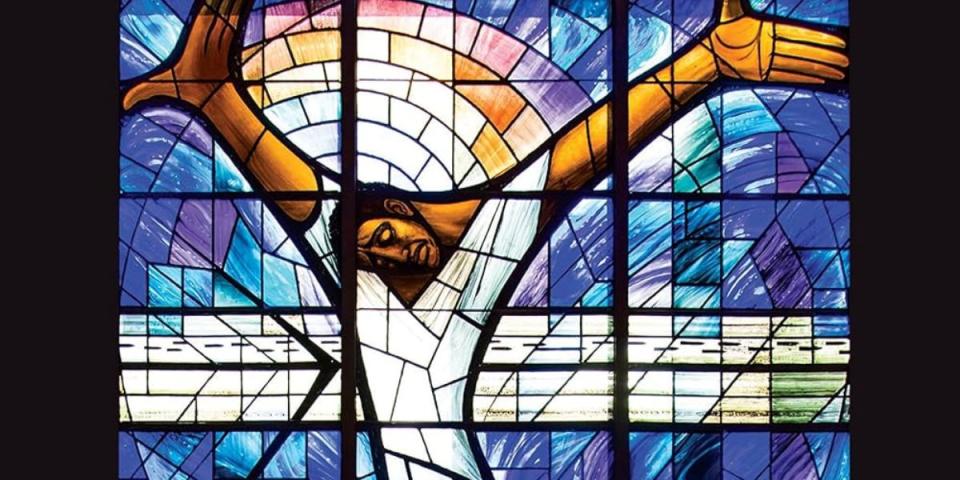
Thousands of Welsh locals lined up to contribute. Many of them were school children who brought their pocket change. Within a short time, the money was raised and the ‘Welsh Window’ was installed and dedicated at 16th St. Baptist Church in Birmingham in 1965, just two years after the bombing. It is now recognised throughout the world as one of the civil rights movement’s most iconic pieces of art. (Italso serves as the cover image of Fleming Rutledge’s 2015 magnum opus, The Crucifixion: Understanding the Death of Jesus Christ.)
The window depicts a black Christ with his right hand pushing away hatred and injustice, while his left hand offers forgiveness. Over the top, there is an overarching rainbow, likely representing the rainbow we behold in the Book of Revelation (4:3; 10:1), where John sees the throne of God surrounded by the sign of God’s covenant of peace with Noah after the flood.
The blue surrounding Christ is the sea, the waters of the world, no longer a tempestuous source of disorder and chaos, but now a tamed, smooth, and glassy sea, spreading out before God’s throne into the new creation (Revelation 4:6; 21:1).
The inscription, “You do it to me,” is taken from the parable of the Last Judgement (Matthew 25:40). As Rutledge comments,
The choice of words in the window is striking, because Jesus’ saying takes on a different meaning in the context of his crucifixion. The acts of mercy commended by the Lord in Matthew 25 as done to him in the persons of “the least of these” are, here, depicted as their opposite: the full force of universal human depravity is turned upon him.
When I stood outside 16th St. Baptist Church that Sunday afternoon in 2019, tears filled my eyes as I first made out the words of Genesis 50:20 on that faded plaque, overwhelmed by the courage of a wounded community interpreting its suffering through trust in God’s providence.
That experience has stayed with me, returning to mind whenever I contemplate the Welsh Window and its testimony to how Christ’s sacrifice transfigures human suffering. I have thought of it often in my parish ministry, especially when accompanying people through seasons of grief. The window has become, for me, an apt image of pastoral work: a call to bear witness to the light of Christ as it passes—like light through stained glass—into lives marked by sorrow, yet by God’s grace still capable of shining with the refracted luminosity of faith, hope, and love.
And so, the witness of the deaths of those four girls, of the church that mourned them, and of the people of Wales who reached across an ocean in solidarity, all point toward the same reality proclaimed in Revelation 7:16-17. The martyrs, the innocent victims of this violent world with its disregard for human life, shall be brought out of the great tribulation.
People of every colour, tribe, nation and tongue will cry out with a loud voice: Salvation belongs to our God who is seated on the throne, and to the Lamb! The one who is seated on the throne will shelter them. They will suffer no more, and God will wipe away every tear from their eyes (Revelation 7:9-17, NRSV).
No act of hatred will have the final word, and every tear will indeed be wiped away. In the meantime, we walk by that light—the Lamb’s light—trusting that the God who gathers the world’s pain into the redeeming life of Christ is even now making all things new.
Image: Detail from the Welsh Window, 16th St Baptist Church, Birmingham, Alabama


